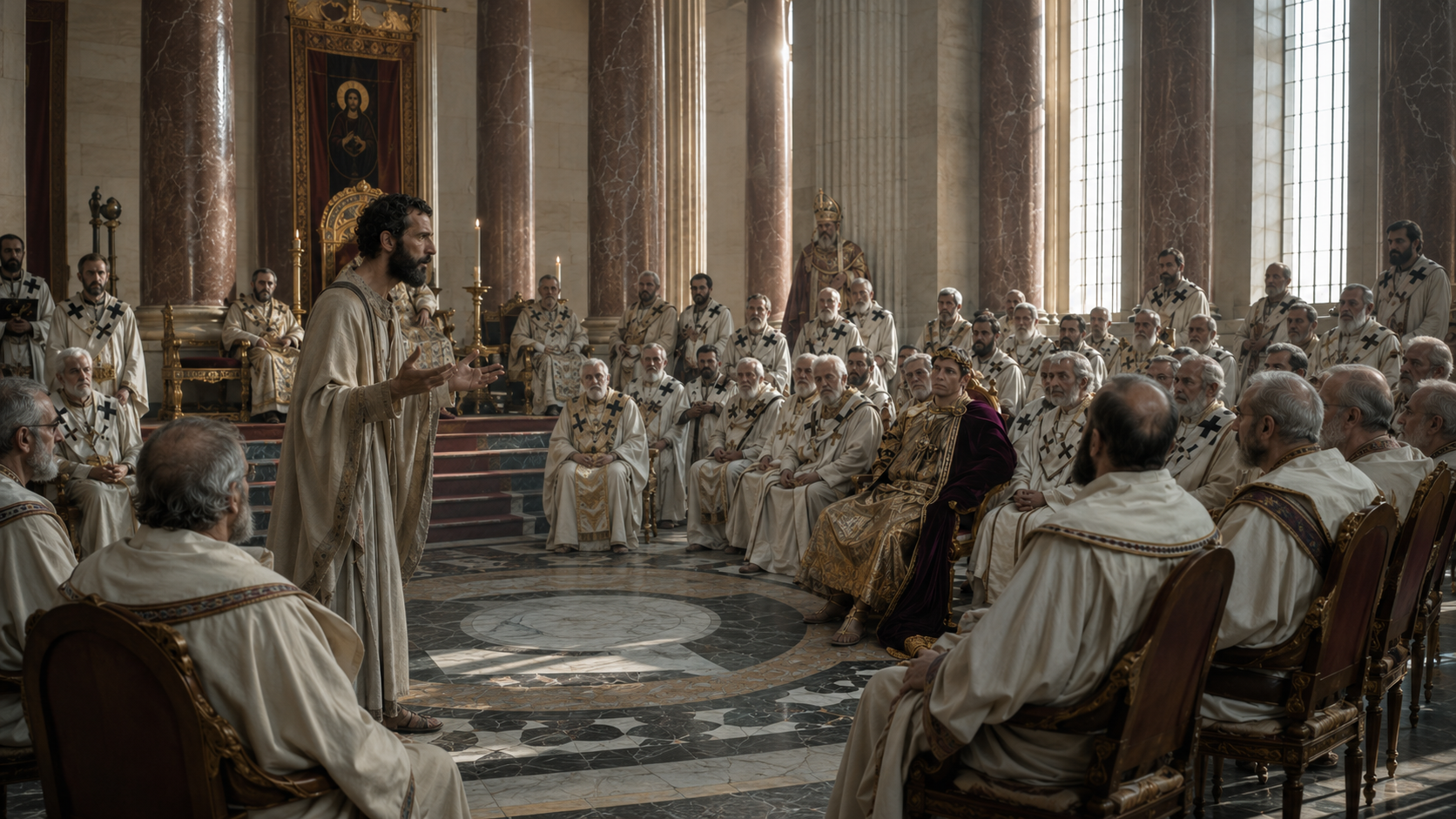
The Islamic claim against Christianity is as follows: Jesus preached the simple oneness of God; his followers gradually deviated, first promoting Jesus to deity and later adding the Holy Spirit; and at the Council of Nicaea in AD 325 the divinity of Jesus was finally imposed by political authority. It is a popular tale - but it is almost the exact reverse of what happened.
The proceedings of Nicaea are no secret; the records can still be read. Church leaders gathered from Africa, Asia and Europe - even representatives from Britain, Spain and India - because they were alarmed that Arius of Alexandria was introducing something new. Their stated aim, again and again, is the refusal to innovate: no new doctrine of God, only the ancient doctrine received from Moses, the prophets and the Psalms - and when they argued for the deity of the Son, it was mostly the Old Testament they reached for. Their great word,
Where, then, did Arius get his new doctrine? From the most brilliant pagan mind of the age. Plotinus had perfected Greek philosophy into what we now call Neoplatonism, crowned by his concept of “the One”: divinity as absolute simplicity - beyond change, beyond contact, beyond even awareness of anything else. The One is so perfect it can contemplate only what is perfect, which is itself; a universe is not worthy of its attention, so the world does not come from a Creator’s loving purpose but simply oozes out of the One, unnoticed.2 Reacting against the squalid soap opera of the Greek gods, Plotinus reached for a deity at the maximum conceivable distance: solitary, timeless, emotionless - for emotion is weakness - and utterly unrelated. In that scheme, divinity is distance.
This is what Arius believed. If that is what the word “God” really means, then Jesus - who made the world, became flesh, wept, ate and died - cannot be the true God. He must be a lesser, created, diluted divinity, brought into being to handle the messiness the pure God cannot touch. “There was once when he was not.” It sounded reverent. It was the Neoplatonic One wearing Christian clothes.
The church’s answer was Colossians: in Jesus all the fullness of deity dwells bodily (Colossians 1:15-16). He is not God diluted but God at full strength - and, as Athanasius insisted, the only system of thought that will fit Jesus must begin with Jesus, not squeeze Him into a philosophy built without Him. So, when someone says “the Trinity came from Greek philosophy,” we may gently answer: it was the denial of the Trinity that came from Greek philosophy. The idea that God is too absolute, too distant, to have a Son and to come among us is precisely the philosophers’ god - not the God of Abraham who came down to the burning bush.
If Nicaea invented nothing, then the evidence must stand in the pages of the New Testament itself — and it does. Dozens of passages could be brought forward; here are ten, beginning where the public ministry of Jesus begins, showing that the most staggering claims do not emerge gradually over the centuries but are there from the start, made by Jesus and understood by everyone who heard them.
Matthew 3:16-17 – Jesus' baptism in the Jordan river: The public ministry of Jesus opens with the whole Trinity present and active: the Son standing in the water, the Spirit descending like a dove, the Father’s voice from heaven - “This is my beloved Son.” And notice where the Son is standing: in a baptism of repentance, among the sinners. John protests, but heaven does not. The Father delights in the Son who gets into the water with sinners,3 and the Spirit visibly rests upon Him. Nothing could be further from the philosophers’ Neo-Platonic distant God.
John 5:16-23 - equal with God: Challenged for healing on the Sabbath, Jesus answers, “My Father is working until now, and I am working.” His hearers understood precisely: he “was even calling God his own Father, making himself equal with God.” Jesus does not correct them. He goes further: whatever the Father does, the Son does likewise - “that all may honour the Son just as they honour the Father.”
Mark 2:1-12 - “Who can forgive sins but God alone?” : To the paralysed man lowered through the roof Jesus says, “Son, your sins are forgiven” - and the scribes reason, “Who can forgive sins but God alone?” Their theology is impeccable - and so is the LORD’s ancient promise about the Angel He would send ahead of Israel: “he will not pardon your transgression, for my Name is in him” (Exodus 23:21) - the Sent One with divine authority over pardon. Jesus reads their thoughts - itself a divine prerogative4 - accepts their premise, and heals the man “that you may know that the Son of Man has authority on earth to forgive sins.”
John 8:56-59 - “Before Abraham was, I AM”: “Your father Abraham rejoiced that he would see my day; he saw it and was glad.” The crowd objects: you are not yet fifty - you cannot have met Abraham. Jesus does not soften anything: “Truly, truly, I say to you, before Abraham was, I AM” - the Name from the burning bush (Exodus 3:14, on His own lips. They picked up stones to throw at Him. They understood exactly what He claimed.
John 10:27-33 - “I and the Father are one”: “My sheep hear my voice… I give them eternal life.” His hearers knew who the Shepherd of Israel is: “The LORD is my shepherd”; “I myself will be the shepherd of my sheep.”5 Then: “I and the Father are one” - a plural verb (“are”), one being: a unity, not a solitary person. The reaction: stones, “because you, being a man, make yourself God.”
Matthew 22:41-46 - David’s LORD and David’s Lord: At the end of Holy Week’s interrogations, Jesus asks His own question: whose son is the Christ? “David’s,” say the Pharisees. Then how is it that David, in the Spirit, calls him Lord - “The LORD says to my Lord: Sit at my right hand”? If David calls him Lord, how is he his son? No one was able to answer a word.
Mark 14:61-64 - the trial: “Are you the Christ, the Son of the Blessed?” - “I AM; and you will see the Son of Man seated at the right hand of Power, and coming with the clouds of heaven.” Psalms 110 and Daniel 7 in a single sentence: the Son of Man who approaches the Ancient of Days as an equal, receives everlasting dominion, and is worshipped by all peoples.6 The high priest tears his clothes: “You have heard his blasphemy.” Pilate executed Jesus for political reasons; the religious authorities condemned Him for this claim. He was crucified for it.
John 17:1-5, 24 - glory before the world existed: On the night He was betrayed: “Glorify me in your own presence with the glory that I had with you before the world existed… you loved me before the foundation of the world.” Here the eternal life of God is laid open before creation - the Father loving the Son in divine glory. But the LORD says, “My glory I give to no other” (Isaiah 42:8). If Jesus had the LORD’s glory, He is the LORD.
Matthew 28:18-20 - one Name, three persons: “All authority in heaven and on earth has been given to me… baptising them in the Name” - singular - “of the Father and of the Son and of the Holy Spirit.” One Name; three persons. Try inserting any creature into that formula - “in the name of the Father, the Son and Moses” - and you feel the impossibility at once. Father, Son and Spirit stand together on the Creator’s side of the Creator-creature line.
1 Corinthians 8:4-6, Colossians 1-2, Hebrews 1 - the apostolic witness: Paul takes the Shema itself - “there is no God but one” - and places the Father and the Lord Jesus inside it: “one God, the Father, from whom are all things… and one Lord, Jesus Christ, through whom are all things.” Colossians declares Him the visible form of the invisible God, in whom “the whole fullness of deity dwells bodily.” And Hebrews 1 proves the Son’s deity entirely from the Old Testament - Psalms 45, Psalms 102, Psalms 110 - the Father Himself addressing the Son as God, LORD and Creator, and commanding the angels to worship Him.
Notice a pattern running through these passages: always pay attention to the hostile audience. The scribes, the Pharisees, the crowds and the high priest were soaked in the Scriptures, and at every point they grasped precisely what Jesus was claiming - “making himself equal with God”; “you, being a man, make yourself God”; “blasphemy!” They are our best witnesses.
And at any moment Jesus could have cleared up the misunderstanding. A faithful prophet who had been misheard as claiming deity would have been horrified, and would have said so at once. Jesus does the opposite: every time, He doubles down - whatever the Father does, I do; honour me as you honour the Father; before Abraham was, I AM. His enemies understood Him and killed Him for it; His friends understood Him and worshipped Him - “My Lord and my God!” (John 20:28), words Jesus accepts and blesses. There is no gradual exaltation of Jesus over the centuries: the highest claims stand at the beginning, on His own lips.
It is true: Jesus never pronounced the bare sentence “I am God.” But far from undermining His deity, this is exactly what we should expect. In the language of Scripture, the word “God,” standing alone, normally names the Father - “God so loved the world that he gave his only Son” (John 3:16) - because the Father is the source and fountain of the divine life: He eternally begets His Son and breathes out His Spirit, who are of His very being - the same nature, the same life.7 So on the lips of Jesus, “I am God” would have been heard as “I am the Father” - and that is precisely what He is not.
Instead, Jesus says exactly what the eternal Son should say: sent by the Father (John John 4:34, John 5:36-37); doing everything the Father does (John 5:19); one with the Father (John 10:30); “whoever has seen me has seen the Father” (John 14:9); sharing the Father’s glory before the world began (John 17:5); “before Abraham was, I AM.” (John 8:58) Some hear “the Father sent me” (John 5:36-37) as proof that Jesus is a mere messenger. The original hearers heard those same words and reached for stones to stone him to death (John 5:18, John 8:59). Being sent is no mark of inferiority in the Bible; Jesus receives it as the highest honour - the Father entrusting to Him all the divine work of creating, judging and rescuing the world. It is the eternal signature of the Son (Isaiah 48:16). It is only Arius' idea of God - where greatness means staying at a distance - that says a divine Jesus could never be sent. In the Bible it is the opposite: being sent is not beneath the Son; it is His glory.
A second objection says that confessing the Son and the Spirit adds partners to God. But nothing is being added. The Father, the Son and the Spirit are never three separate agents who sometimes team up: everything the Father does - creation, redemption, resurrection - is done through the Son in the power of the Spirit, for they are His own Word and His own Breath. Was God ever speechless? Ever without breath? A word is not a second being standing over against the speaker; it is the speaker’s own self-expression. The early church loved to say that the Son and the Spirit are the Father’s two hands, of His own nature, by which He does everything He does.8 We have not associated creatures with the Creator; we have refused to amputate from God His own eternal Word and Spirit.9 The solitary, silent, sealed god is the smaller conception of deity.
Nor does the eternal begetting have anything to do with bodies, time or marriage. The Son is begotten as a word is begotten of a mind, as radiance is begotten of light - “the radiance of the glory of God” (Hebrews 1:3); “Light from Light,” as the creed says. The sun has never existed without its shining; the Father has never existed without His Radiance. That is why God has been love from all eternity - the Father loving the Son in the joy of the Spirit before the foundation of the world (John 17:24) - never a lonely god who had to create in order to have someone to love.
And “one and three” is a contradiction only if both are meant in the same sense - which Christians have never said. Three persons - the Speaker, the Word, the Breath; one God - one being, one life, one Name. There is no contradiction to defend, so decline, politely and cheerfully, every invitation to defend one. The real question is never “how can one equal three?” but “who has God revealed Himself to be?” - and from the first page of Moses to the last page of John, the answer is constant.
Trace these ten witnesses back through the Scriptures and the whole Bible speaks with one voice. The Father who sends His Son in the power of the Spirit on the first page of Genesis (Genesis 1:1-3) is the Father whose voice breaks open the heavens as Jesus is baptised in the Jorden river. (Matthew 3:16) The Sent One who carries the Name and pardons sin at Sinai is the Son of Man who forgives the paralysed man in Capernaum (Mark 2). The I AM of the burning bush speaks again outside the temple: “before Abraham was, I AM.” There is no higher, purer deity concealed behind Jesus. What we see in His face is all the fullness of God - the God who does what the god of the philosophers never could: come down, draw near, and love us to the very end.