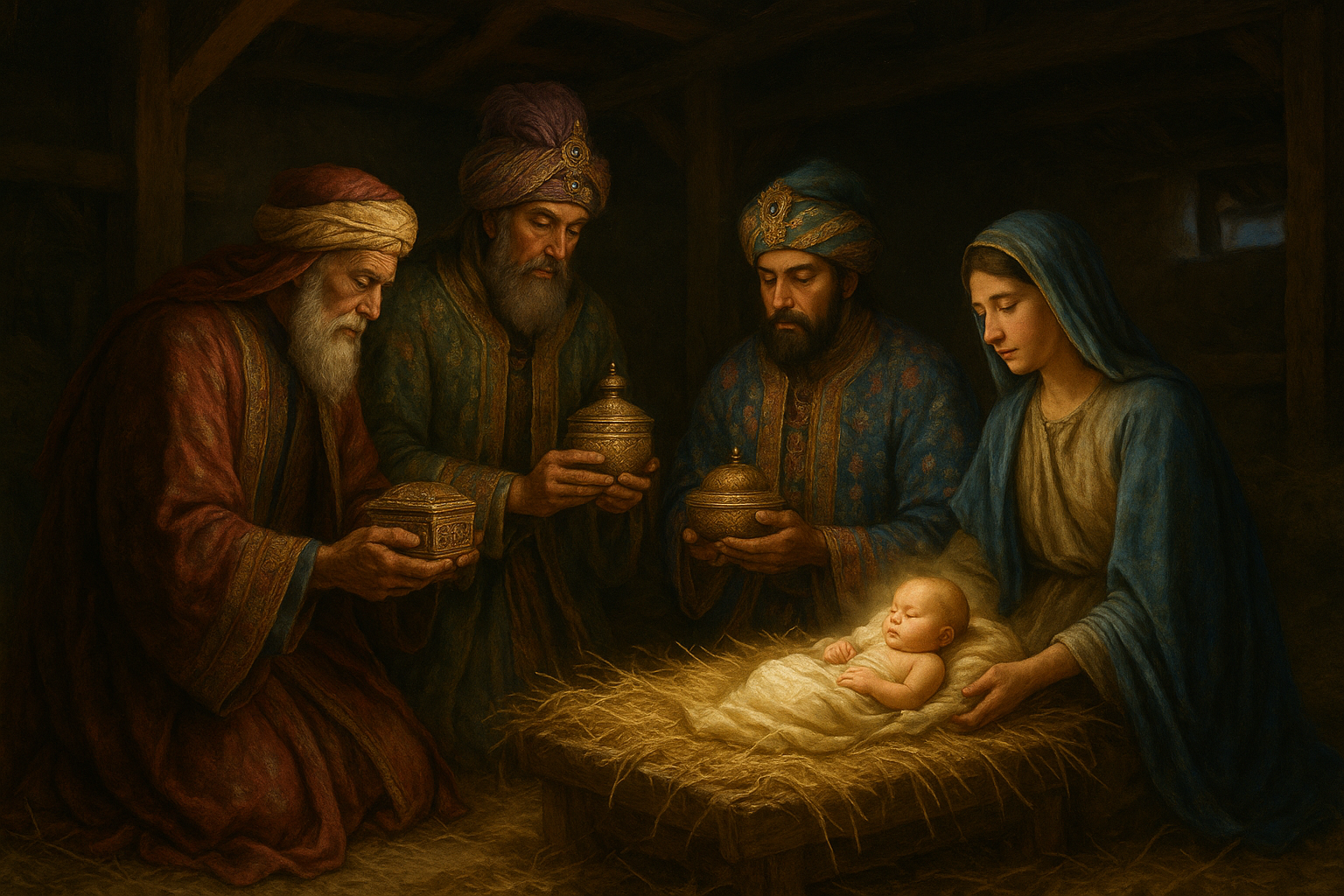
Now when Jesus was born in Bethlehem of Judaea in the days of Herod the king, behold, there came wise men from the east to Jerusalem, saying, ‘Where is he that is born King of the Jews? for we have seen his star in the east, and are come to worship him.’ (Matthew 2:1-2).
‘Wise Men’ is Greek magoi – magi. The Magi were the priests of Zoroastrianism – the religion of ancient Iran (the most famous modern Zoroastrian was Freddie Mercury of Queen). Zoroastrian temples stretched from Armenia to Afghanistan and Central Asia and south to the borders of modern Yemen.
Matthew 2:1 tells us only that the Magi came from ‘the east’. This enigmatic reference may reflect that the Magi came from the rival of the Roman Empire, the Parthian or Arsacid Empire, which included Babylon and Iran, and all land eastwards to western Pakistan. Hence, people from the other super-power came to honour not Emperor Augustus or King Herod, but rather Jesus – the child recently born in Bethlehem.
Zoroastrians had elements of astrology in their beliefs, so God used these to bring them to Jesus through a miraculous Star that moved – guiding them first to Jerusalem, and then, after they were informed of what the Bible said about where the Messiah would be born, to the house in Bethlehem.
Zoroastrianism had a belief in a future Deliverer called the Saoshyant, the ‘benefactor’. He is described in Zoroastrian scriptures as ‘the man who is better than a good man’, (Yasna 43:3): ‘who would teach us the straight paths of blessedness in this life ... a faithful man, well-knowing and holy’ The Saoshyant would be virgin-born. The virgin’s son would be Astvat-ereta – ‘He who embodies righteousness’, v16 – ‘May Right be embodied full of life and strength!’ They also believed that the Saoshyant would destroy the power of demonic forces.
Jesus was indeed born of a virgin, and He would indeed embody righteousness – ‘...an angel of the Lord appeared to him in a dream and said, “Joseph son of David, do not be afraid to take Mary home as your wife, because what is conceived in her is from the Holy Spirit. She will give birth to a son, and you are to give him the name Jesus, because he will save his people from their sins.” All this took place to fulfil what the Lord had said through the prophet: “The virgin will conceive and give birth to a son, and they will call him Immanuel” (which means “God with us”).’ Matthew 1:20-23
He also came to destroy the power of demonic forces, 1 John 3:8: ‘The reason the Son of God appeared was to destroy the works of the devil.’
Note that the Magi brought Jesus gifts and that they worshipped Him, Matthew 2:11 says ‘And going into the house, they saw the child with Mary his mother, and they fell down and worshipped him. Then, opening their treasures, they offered him gifts, gold and frankincense and myrrh.’ It is known that Seleucus II, King of Syria, 243 BC, offered these three gifts to the god Apollo at the temple of Miletus1. Hence, these were sacrificial offerings to a divine being. By bringing these offerings, and worshipping Jesus, the Magi from Iran recognised that the Child born in Bethlehem was indeed divine.
It follows that not only at Christmas, but always, the proper response to Jesus – the virgin-born Deliverer who destroys the power of the Devil – is to worship Him as the One who is BOTH Man and God. Make sure that this Christmas, you join with the Magi in worshipping Jesus, and looking to Him for salvation.
Why not take some time to watch the Christmas story and learn more about who Jesus is and why he came by watching the video below.