Many Christians grow tense when the Trinity comes up in conversation. Feeling it is the weakest point of the faith, they reach in panic for analogies - water, ice and steam; a clover; an egg - and without knowing it, have described not the living God but something closer to an ancient heresy - and so we avoid talking about it. Bishop Lesslie Newbigin put to a friend the challenge: too many of us keep the Trinity in a paper bag under the shop counter, when it belongs in the shop window. The Trinity however, is the best thing we have - it’s not a problem to be managed but the answer to every problem.
We need to do two things. First, we cannot explain a reality we have not come to love. The deepest preparation is worship of the living God, Father, Son and Spirit, becoming our daily bread, our obsession, our joy. People will always notice our defensiveness, but also our delight.
Too many of us keep the Trinity in a paper bag under the shop counter, when it belongs in the shop window
Second, nothing illogical is being claimed in the Trinity. No creed, council or church father ever asserted that God is one being and three beings, or one person and three persons1. Christians say the Father, Son and Spirit are three in one sense (three persons) and one in another (one God, one being, one life). There is nothing incoherent there - no more than saying evening and morning are one day, or a man and his wife one flesh; and that, as we will see, is Moses’ own language. The Trinity is a mystery only in the biblical sense: an open secret, revealed and wonderful, inexhaustible - but never an absurdity.
It is vital to distinguish the doctrine of the Trinity from the reality of the Trinity. “Doctrine” simply means teaching - the church’s way of explaining this truth, sometimes in dauntingly technical vocabulary (“three hypostases perichoretically adhering in one ousia”). Such definitions are careful and good, but they require philosophical training, and the Bible itself never bothers with them.
The reality is something else entirely: there is a Father, the Most High, who sends His Son in the power of His Spirit. That is the most ancient reality of all - older than the universe, because the universe was made by the Father speaking His Word by His Breath. It stands on the first page of the Bible and runs through Moses, the patriarchs, David and Isaiah into the New Testament.
Think of electricity. Every one of us has used it today, yet few could give a competent account of electromagnetic theory. Struggling with the theory is not being a stranger to the reality. A Christian who cannot operate the councils’ vocabulary, but who knows and loves the Father who has sent His Son in the power of the Spirit, knows the Trinity.
It is often claimed that the Trinity was invented at the Council of Nicaea in the fourth century. The truth is precisely the opposite. When the church leaders of that era reached for philosophical terms - essence, substance, person, hypostasis - they did so because a genuinely new teaching about God was emerging, and they were determined to resist it. The technical vocabulary was a fence built around an ancient treasure. The innovators of the fourth century were the heretics; Nicaea was defending the ancient faith.
However, the evidence for the Trinity reaches far behind Nicaea. The first writer known to use the word Trias - Trinity - was Theophilus of Antioch in the second century, and he used it, strikingly, in a comment on Genesis 1.2 That is no accident: the people of God have spoken of the Father, His Word and His Spirit from the very beginning, because that is where the Bible itself begins.
If the absolute, mathematical oneness of God were the foundational truth of the Old Testament, we would expect it declared on page one. It is not. Genesis passes - creation, flood, patriarchs - with no such statement; so do Exodus, Leviticus and Numbers. The confession finally arrives in the fifth book: “Hear, O Israel: the LORD our God, the LORD is one” (Deuteronomy 6:4) - not a philosophical foundation on page one, but a climax: after everything God has shown Israel, He alone is God, not the idols of Egypt and Canaan. The Shema confesses “the LORD - and no other.”
And Moses chose his word with care. Hebrew has a word for absolute, solitary oneness: yachid - used of Isaac as Abraham’s one-and-only son.3 Moses does not use it. The Shema says the LORD is echad - the ordinary word for “one” that Scripture happily applies to composite unities4: evening and morning are one (echad) day (Genesis 1:5); a man and his wife become one (echad) flesh (Genesis 2:24); the spies carry back one (echad) cluster of grapes (Numbers 13:23)5
The Bible never once asserts that God is solitary. A solitary god, existing from eternity with no one to love, would be pitied rather than worshipped. The real and living God is a unity of love and power. When the confession of oneness finally comes, it gathers up everything the first four books have shown us: all of that is the LORD, and there is no other.
Fifty or sixty passages could be used to show the Trinity in the Old Testament, but the following ten verses show the shape of the whole - drawn mostly from the books of Moses, the foundation on which the prophets, the Psalms and the New Testament all build.
Genesis 1:1-3 - the first page: In the Bible’s first three verses we meet God, the Spirit of God hovering over the waters, and the Word that God speaks - the Speaker, His Breath and His Word, before the light even exists. Psalms 33:6 reads Genesis 1 exactly this way: “By the word of the LORD the heavens were made, and by the breath of his mouth all their host.” When John opens his Gospel - “In the beginning was the Word” - he is not reading anything in. He is reading it off the page.
Genesis 1:26 - divine deliberation in the plural: The first recorded words of divine deliberation are plural: “Let us make man in our image.” Nor is it an isolated slip: “the man has become like one of us” (Genesis 3:22); “Come, let us go down” (Genesis 11:7); “Whom shall I send, and who will go for us?” (Isaiah 6:8) - singular and plural in a single breath. This cannot be God consulting angels: humanity is never made in the image of angels, and angels create nothing. Nor is it a “plural of majesty” - no Hebrew king in Scripture speaks that way.
Genesis 16:13 - the Angel who is God: Hagar, alone and pregnant in the wilderness, is found by the Angel - literally, the Sent One - of the LORD. He speaks as God in the first person, and Hagar names Him: “You are the God who sees me.” Scripture records and narrates this without correction.
Genesis 18-19:24 - the LORD on earth and the LORD in heaven: “The LORD appeared to Abraham” by the oaks of Mamre - never rush past that phrase. He eats a meal, hears Abraham’s pleading over Sodom, and then Moses writes an extraordinary sentence: “the LORD rained on Sodom and Gomorrah sulphur and fire from the LORD out of heaven” (Genesis 19:24). The LORD on earth, sent from the LORD in heaven - two named as Yahweh in one verse; yet the LORD is one, a unity.
Genesis 48:15-16 - Jacob’s threefold blessing: “The God before whom my fathers walked, the God who has been my shepherd all my life, the Angel who has redeemed me from all evil - may he bless the boys.” Three named; one singular verb. Jacob, who had wrestled with this man and declared “I have seen God face to face” (Genesis 32:30), knows exactly who his God is - and Hosea confirms it: Jacob strove with God, and wrestled with the Angel.6
Exodus 3 - the burning bush: “The angel of the LORD appeared to him in a flame of fire” - and within two verses it is God who calls from the bush and the LORD who says, “I have come down to deliver.” Moses piles the titles on: this person is the Angel of the LORD, He is God, He is the God of Abraham, Isaac and Jacob. He never says, “Let me tell you what God says” - He speaks as God, because He is God: the Sent One who is the LORD, whose presence makes the ground holy.
Exodus 23:20-21 - “My Name is in him”: In the Exodus, the LORD, hidden in thick darkness on the mountain, promises to send His Angel ahead of Israel: “Pay careful attention to him and obey his voice… for he will not pardon your transgression, for my Name is in him.” No created angel forgives sins, and no creature bears the sacred Name. The Sent One carries the Name and holds divine authority over the pardon of sin.
Numbers 6:24-26 - the threefold blessing: God gives the priests the words with which to bless His people: “The LORD bless you… the LORD make his face shine upon you… the LORD lift up his countenance upon you.” Three times the Name; one blessing; one God. God’s people have been blessed in a threefold name since Moses - and the church still baptises in one name: the Father, the Son and the Holy Spirit. (Matthew 28:18-20)
Deuteronomy 32:8-9, Psalms 45:6-7 and Psalms 110:1 - the LORD who has a God: Deuteronomy, the very book that gives us the Shema, the great confession that "the LORD is one" (Deuteronomy 6:4) - also speaks of a divine plurality. The Most High divides the nations - and allots the people of Jacob to the LORD as His inheritance. The LORD receives an inheritance from the Most High: the Father gives a people to His Son (Deuteronomy 32:8-9). Psalms 45 addresses the King directly: “Your throne, O God, will last for ever… therefore God, your God, has anointed you with the oil of joy” - God anointed by God, quoted of the Son in Hebrews 1.7 And Psalms 110: “The LORD says to my Lord: Sit at my right hand.” David has two Lords.
Isaiah 48:16 - the Sender, the Sent and the Spirit: Here the three persons of the Trinity are seen together in the same passage. Reading the chapter from the beginning to establish the speaker, we see it is the LORD Himself, the first and the last, the Creator of the heavens and the earth. Then this same speaker says: “And now the Lord GOD has sent me, and his Spirit.” God is sent by God, with the Spirit of God - the three divine persons in one verse, seven centuries before Christ. At Nazareth, Jesus read the same pattern from Isaiah 61 and announced, “Today this Scripture is fulfilled.”
Taken together, these passages are not a collection of isolated oddities. When speaking of God, these verses, and others, follow a single, consistent pattern, or grammar, that appears throughout the Old Testament: the Most High; the LORD who comes down, walks, appears, eats, wrestles and is sent - the Word, the Voice, the Angel, the Name; and the Spirit, the Breath of God, who broods and fills. Always from the Father, through the Son, by the Spirit - always acting as one.
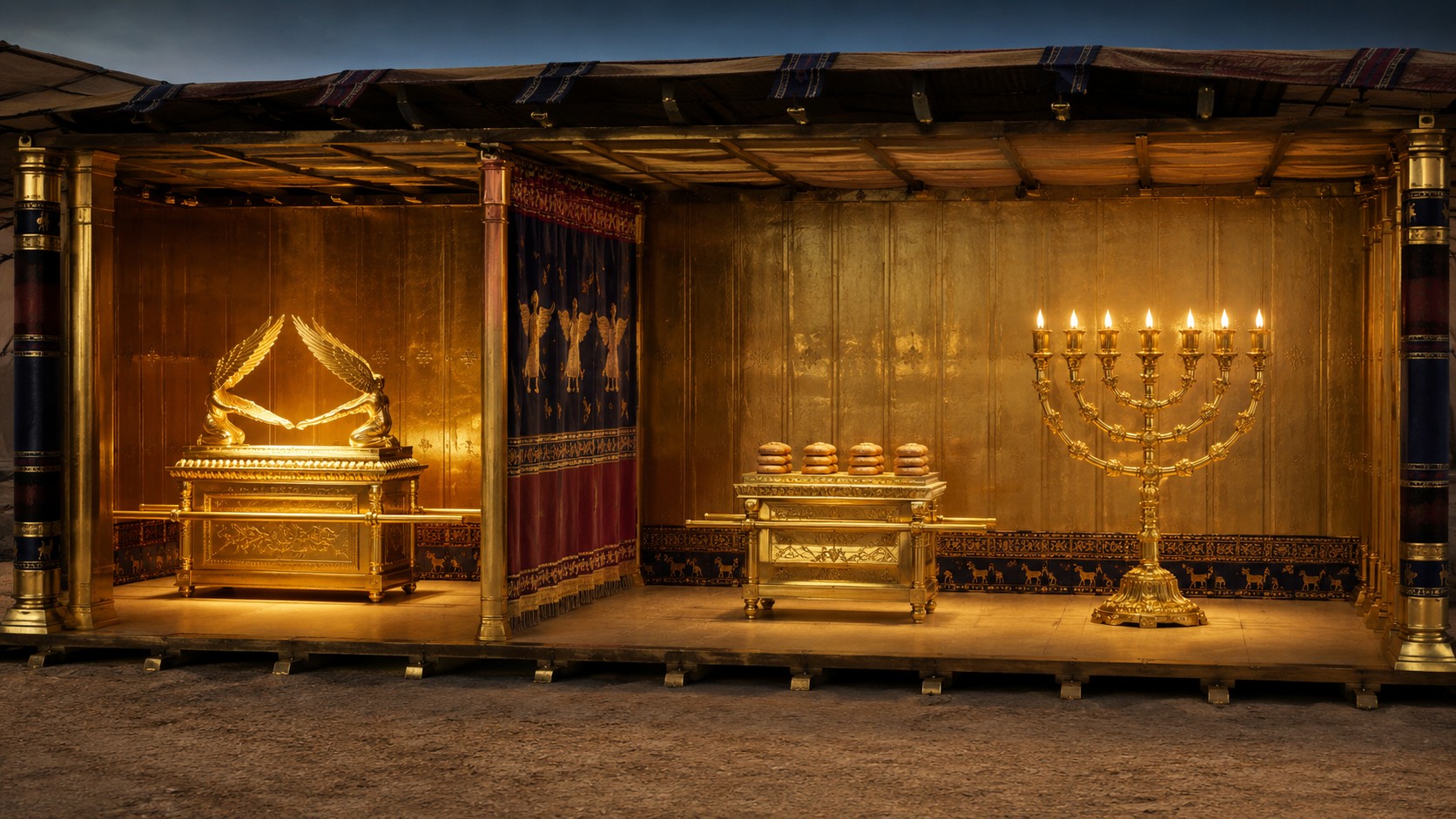
The Tabernacle is the centrepiece of the Bible’s theology: a tent built as a model of the universe, with a heavenly room and an earthly room divided - because of sin - by a curtain, torn from top to bottom when Jesus dies. But before the tent, the curtains or the altar, the LORD commands something remarkable: first make three pieces of furniture, each covered in gold, the material of divinity (Exodus 25). For a time, God’s people contemplate three golden objects with no “universe” yet built to house them - three things, as it were, older than the model of creation itself.
The Ark of the Covenant - the Father. A throne flanked by golden cherubim, later placed in the inner, “heavenly” room. Whenever anyone in Scripture looks into the highest heaven - Daniel, John - they see exactly this: a throne surrounded by angels (Daniel 7; Revelation 4). “The LORD reigns; he sits enthroned upon the cherubim” (Psalms 99:1).
The Table of the Bread of the Presence - the Son. A golden table bearing twelve loaves, in the outer, “earthly” room. “Presence” is literally face - the bread of God’s Face, the divine person who can be seen: “my Presence will go with you” (Exodus 33:14); “the Angel of his Presence” (Isaiah 63:9). When the Presence became flesh, a third of Jesus’ ministry happened around food - until He said what the golden table had been saying for fifteen hundred years: “I am the Bread of Life” (John 6:35).
The Golden Lampstand - the Spirit. A golden tree of seven branches burning with pure olive oil - and oil is always the Spirit’s sign (“the oil of joy,” Psalms 45). Scripture interprets the lampstand twice. Zechariah sees it and is told: “Not by might, nor by power, but by my Spirit, says the LORD” (Zechariah 4:2-6); and John sees seven torches of fire before the throne, “which are the seven spirits of God” (Revelation 4:5).8
Morning and evening, Israel worshipped inside a golden diagram of the Trinity, built “after the pattern shown you on the mountain” (Exodus 25:40).9 And notice where the pieces stood: the Ark behind the curtain in the heavenly room; the Table and the Lampstand on this side of it. The Father remains enthroned in heaven, while symbolically the Son and the Spirit cross into the earthly room, to be with an exiled people - as if to say to Adam and Eve, “You need to leave my presence, but we are coming with you, because we cannot let you go alone.”
The Trinity, then, is not a late add-on to biblical faith. It is the structural architecture of the whole revelation of God, from the first verse of Genesis to the furniture of the Tabernacle - which could not even be built until the golden pieces had been contemplated. Everything God does, on every page, is done one way: from the Father, through the Son, in the power of the Spirit - without exception. That is the oldest grammar of the Bible. The oneness finally confessed in the Shema is the oneness of this God: not a solitary monad, but the LORD who is a unity of love and power - and there is no other.